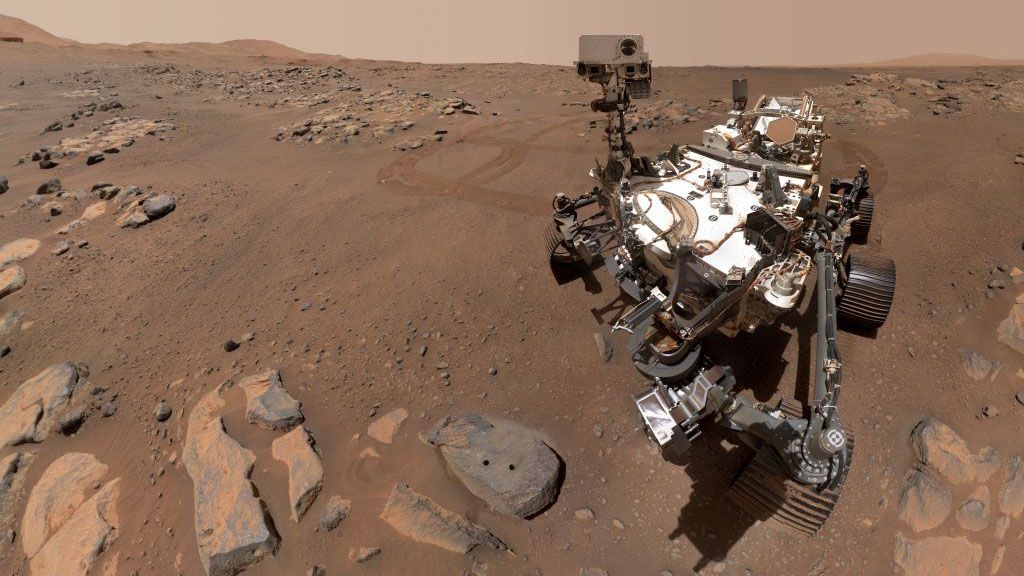
Nasa rover detects potential signatures of ancient microbial life on Mars
NASA's Perseverance rover appears as a green speck on the Martian surface on June 13, 2026, a day before the robotic explorer marked a distance milestone,…
- Center-left3
- Center2
- Public / State1
2 agency rewrites / co-publications detected
Summary
NASA's Perseverance rover appears as a green speck on the Martian surface on June 13, 2026, a day before the robotic explorer marked a distance milestone, having traveled a full marathon (26.2 miles, or 42.195 kilometers) on the Red Planet. Measurements taken by the rover’s Sherloc instrument identified organic carbon in mudstones from the Bright Angel outcrop as it trundled along Neretva Vallis, a dried-up river that carried water into the planet’s Jezero crater billions of years ago. Perseverance identifies organic carbon molecules in rocks on riverbed that carried water billions of years ago Nasa’s Perseverance rover has detected complex carbon molecules in Martian rocks that are already in the spotlight for bearing potential signatures of ancient microbial life.
Furthermore, Perseverance reached that distance after five years and four months of driving—on the 1,890th Martian day (sol) of its mission; the previous record holder, NASA's Opportunity rover, took 11 years and two months to reach the same milestone. Chelsea Gohd served as a Senior Writer for Space.com from 2018 to 2022 before returning in 2026, covering everything from climate change to planetary science and human spaceflight in both articles and on-camera in videos. When not writing, editing or filming something space-y, Gohd is writing music and performing as Foxanne, even launching a song to space in 2021 with Inspiration4.
In addition, NASA’s HiRISE Captures Perseverance Marking a Milestone on Mars. Images: Perseverance reaches 'marathon' milestone on Mars.
Cross-referenced from 6 sources.
Factual coreconfirmed by several independent voices
NASA's Perseverance rover appears as a green speck on the Martian surface on June 13, 2026, a day before the robotic explorer marked a distance milestone, having traveled a full marathon (26.2 miles, or 42.195 kilometers) on the Red Planet.
reliability moderate2/2 sources
Reported detailssecondary facts, each attributed to its source
Measurements taken by the rover’s Sherloc instrument identified organic carbon in mudstones from the Bright Angel outcrop as it trundled along Neretva Vallis, a dried-up river that carried water into the planet’s Jezero crater billions of years ago.
according to The Guardian — International Edition +2Perseverance identifies organic carbon molecules in rocks on riverbed that carried water billions of years ago Nasa’s Perseverance rover has detected complex carbon molecules in Martian rocks that are already in the spotlight for bearing potential signatures of ancient microbial life.
according to The Guardian — International Edition +2Perseverance reached that distance after five years and four months of driving—on the 1,890th Martian day (sol) of its mission; the previous record holder, NASA's Opportunity rover, took 11 years and two months to reach the same milestone.
according to Phys.orgChelsea Gohd served as a Senior Writer for Space.com from 2018 to 2022 before returning in 2026, covering everything from climate change to planetary science and human spaceflight in both articles and on-camera in videos.
according to Space.comWhen not writing, editing or filming something space-y, Gohd is writing music and performing as Foxanne, even launching a song to space in 2021 with Inspiration4.
according to Space.comNASA’s HiRISE Captures Perseverance Marking a Milestone on Mars.
according to NASA Breaking NewsImages: Perseverance reaches 'marathon' milestone on Mars.
according to Phys.org
Disputedincompatible versions — to verify
No factual contradiction detected between sources.
Framing by sidesame fact, different words — loaded terms highlighted
No notable framing divergence.
Blind spotwhat one side keeps silent
NASA's Perseverance rover appears as a green speck on the Martian surface on June 13, 2026, a day before the robotic explorer marked a…
omitted byLeft sidecovered byCenterPublic / Agencies
Sources4 sources cross-checked
Center-left1
Public / State1