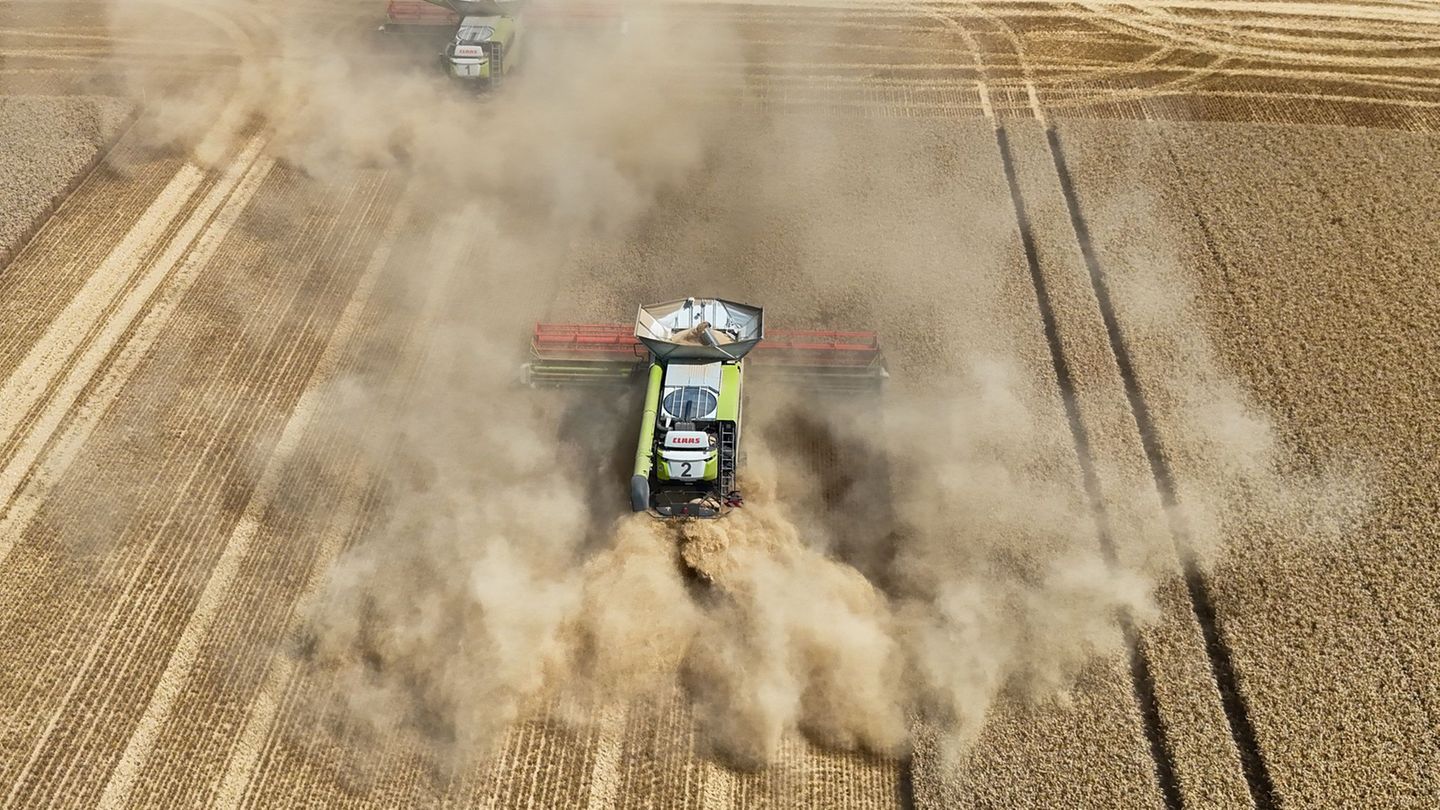
Consequences of drought: worry about harvest: drought and heat hit Europe's farmers
Spanish agricultural cooperatives significantly lowered their forecast in July: The grain harvest is now estimated at around 18.6 million tons – almost two
- Center-left2
- Center-right1
2 agency rewrites / co-publications detected
Summary
Spanish agricultural cooperatives significantly lowered their forecast in July: The grain harvest is now estimated to be around 18.6 million tonnes – almost two million tonnes less than expected in May and around 30 per cent below the exceptionally good harvest last year, which reached almost 27 tonnes. According to the state weather service Météo France, July was the hottest in France since weather records began in 1900. In many places, temperatures above 40 degrees have been recorded.
Furthermore, According to the farmers’ association, winter wheat remains the most important crop with around 2.9 million hectares and a 48 percent share of the grain area in Germany. The French vegetable breeders’ association Légumes de France warned of failures of up to 50 percent and losses of tens of millions of euros. After it had already rained little in June, 70 percent less precipitation fell in July than usual.
In addition, The research network World Weather Attribution describes possible consequences: “Historical crop losses (...) together with the ongoing global conflicts could raise food prices and disproportionately hit low-income households.” “Companies sound the alarm” For this year’s grain harvest in Germany, a below-average result is expected, says Stefanie Sabet, General Secretary of the German Farmers’ Association.
Cross-referenced from 3 sources.
Factual coreconfirmed by several independent voices
Spanish agricultural cooperatives significantly lowered their forecast in July: The grain harvest is now estimated to be around 18.6 million tonnes – almost two million tonnes less than expected in May and around 30 per cent below the exceptionally good harvest last year, which reached almost 27 tonnes.
reliability low1/2 sourcesAccording to the state weather service Météo France, July was the hottest in France since weather records began in 1900.
reliability low1/2 sourcesIn many places, temperatures above 40 degrees have been recorded.
reliability low1/2 sourcesAccording to the farmers’ association, winter wheat remains the most important crop with around 2.9 million hectares and a 48 percent share of the grain area in Germany.
reliability low1/2 sourcesThe French vegetable breeders’ association Légumes de France warned of failures of up to 50 percent and losses of tens of millions of euros.
reliability low1/2 sourcesAfter it had already rained little in June, 70 percent less precipitation fell in July than usual.
reliability low1/2 sourcesThe research network World Weather Attribution describes possible consequences: “Historical crop losses (...) together with the ongoing global conflicts could raise food prices and disproportionately hit low-income households.” “Companies sound the alarm” For this year’s grain harvest in Germany, a below-average result is expected, says Stefanie Sabet, General Secretary of the German Farmers’ Association.
reliability low1/2 sources
Disputedincompatible versions — to verify
No factual contradiction detected between sources.
Framing by sidesame fact, different words — loaded terms highlighted
No notable framing divergence.
Blind spotwhat one side keeps silent
No blind spot detected: every side covers the same facts.
Sources3 sources cross-checked
Center-left2
Center-right1