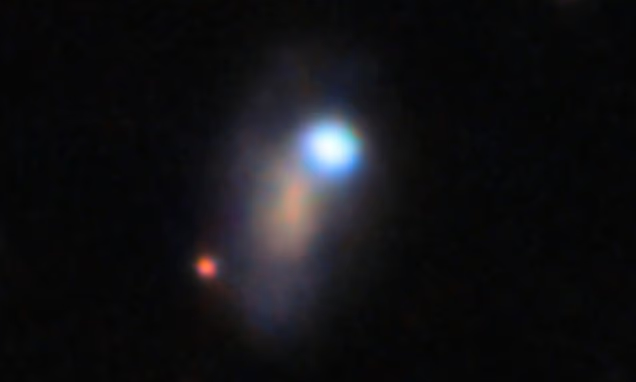
Watch the death of a STAR: Astronomers catch a supernova from the very first explosive moment
Co-author Dr Brendan O’Connor, astronomer at Carnegie Mellon University, says: 'SN 2026gzf looks remarkably similar to other energetic supernovae that have…
- Center-left1
- Right2
2 agency rewrites / co-publications detected
Summary
Co-author Dr Brendan O’Connor, astronomer at Carnegie Mellon University, says: 'SN 2026gzf looks remarkably similar to other energetic supernovae that have been previously linked to gamma-ray bursts. In March earlier this year, the Einstein Probe, an orbiting telescope hunting for high-energy events, spotted a brief flash of X-rays coming from a galaxy 500 million light-years away. Astronomers have captured the death of a star from the very first explosive moments of its demise.
Furthermore, The flash was named EP260321a and immediately the scientific world scrambled to watch its source. In doing so, two teams of scientists both separately identified the first burst of X-rays as a “shock breakout”, which happens when the shock wave from an exploding star bursts out of its surface and sends out the first light of a supernova . In the last two decades, astronomers have only seen one other confirmed shock breakout, making the supernova, dubbed SN 2026gzf, an exceptionally rare discovery.
In addition, However, the SN 2026gzf was extremely unusual in that its initial shockwave wasn't followed by any flash of gamma-rays.
Cross-referenced from 3 sources.
Factual coreconfirmed by several independent voices
Co-author Dr Brendan O’Connor, astronomer at Carnegie Mellon University, says: 'SN 2026gzf looks remarkably similar to other energetic supernovae that have been previously linked to gamma-ray bursts.
reliability low1/3 sourcesIn March earlier this year, the Einstein Probe, an orbiting telescope hunting for high-energy events, spotted a brief flash of X-rays coming from a galaxy 500 million light-years away.
reliability low1/3 sourcesAstronomers have captured the death of a star from the very first explosive moments of its demise.
reliability low1/3 sources
Reported detailssecondary facts, each attributed to its source
The flash was named EP260321a and immediately the scientific world scrambled to watch its source.
according to The IndependentIn doing so, two teams of scientists both separately identified the first burst of X-rays as a “shock breakout”, which happens when the shock wave from an exploding star bursts out of its surface and sends out the first light of a supernova .
according to The IndependentIn the last two decades, astronomers have only seen one other confirmed shock breakout, making the supernova, dubbed SN 2026gzf, an exceptionally rare discovery.
according to Daily Mail +1However, the SN 2026gzf was extremely unusual in that its initial shockwave wasn't followed by any flash of gamma-rays.
according to Daily Mail +1
Disputedincompatible versions — to verify
No factual contradiction detected between sources.
Framing by sidesame fact, different words — loaded terms highlighted
No notable framing divergence.
Blind spotwhat one side keeps silent
No blind spot detected: every side covers the same facts.
Sources3 sources cross-checked
Center-left1