Consequences of drought: low water: chemical industry warns of production cuts
Complex procedures and lack of staff in administration delayed the expected implementation until the 2030s, the association criticizes.
- Center-left1
- Center-right1
1 agency rewrite / co-publication detected
Summary
Complex procedures and lack of staff in administration delayed the expected implementation until the 2030s, the association criticizes. According to the latest data, around 20 million tonnes of chemical products were transported by inland waterway in 2024. BASF, for example, transports 40 percent of the goods at its main plant in Ludwigshafen by ship and now shifts goods partly to trucks and rail.
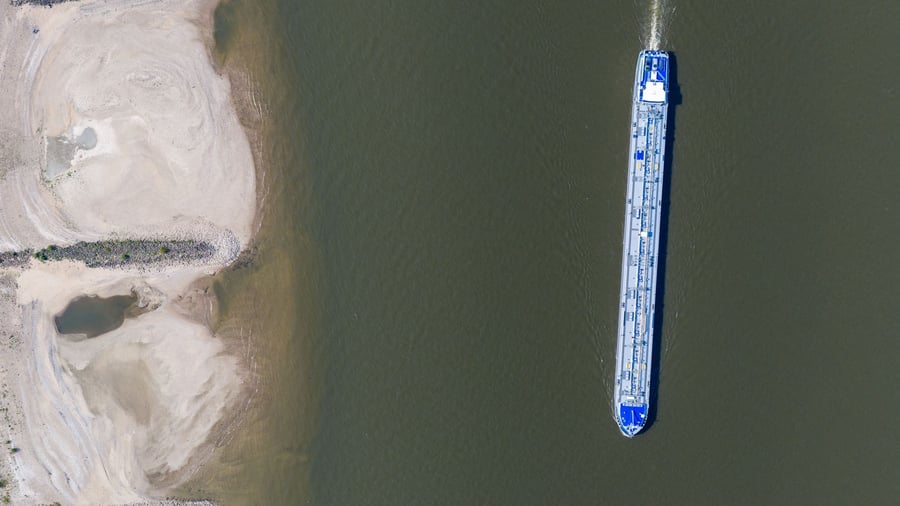
Furthermore, In the chemical industry, where companies such as BASF, Evonik and Covestro are located on the Rhine, chemicals are transported on a large scale over water - including methanol or liquid gases such as butane, propane and ammonia. Although chemical and pharmaceutical companies are prepared for low water, emergency plans do not replace a functioning infrastructure. “The investment backlog on the waterways must finally go,” he demanded before a conference on low water, to which Transport Minister Steffen Bilger (CDU) has invited today in Bonn. The German chemical industry warns against production cuts due to the low water in the Rhine and other rivers. “When ships can load less or cancel completely, costs increase, supply chains come under pressure and production restrictions occur,” said Wolfgang Große Entrup, CEO of the industry association VCI, the German Press Agency.
In addition, On the other hand, the chemical industry has been in crisis for some time, which dampens production - so less transport has to be done.
Cross-referenced from 2 sources.
Factual coreconfirmed by several independent voices
Complex procedures and lack of staff in administration delayed the expected implementation until the 2030s, the association criticizes.
reliability low1/2 sourcesAccording to the latest data, around 20 million tonnes of chemical products were transported by inland waterway in 2024.
reliability low1/2 sourcesBASF, for example, transports 40 percent of the goods at its main plant in Ludwigshafen by ship and now shifts goods partly to trucks and rail.
reliability low1/2 sourcesIn the chemical industry, where companies such as BASF, Evonik and Covestro are located on the Rhine, chemicals are transported on a large scale over water - including methanol or liquid gases such as butane, propane and ammonia.
reliability low1/2 sourcesAlthough chemical and pharmaceutical companies are prepared for low water, emergency plans do not replace a functioning infrastructure. “The investment backlog on the waterways must finally go,” he demanded before a conference on low water, to which Transport Minister Steffen Bilger (CDU) has invited today in Bonn.
reliability low1/2 sourcesThe German chemical industry warns against production cuts due to the low water in the Rhine and other rivers. “When ships can load less or cancel completely, costs increase, supply chains come under pressure and production restrictions occur,” said Wolfgang Große Entrup, CEO of the industry association VCI, the German Press Agency.
reliability low1/2 sourcesOn the other hand, the chemical industry has been in crisis for some time, which dampens production - so less transport has to be done.
reliability low1/2 sources
Disputedincompatible versions — to verify
No factual contradiction detected between sources.
Framing by sidesame fact, different words — loaded terms highlighted
No notable framing divergence.
Blind spotwhat one side keeps silent
No blind spot detected: every side covers the same facts.
Sources2 sources cross-checked
Center-left1
Center-right1